
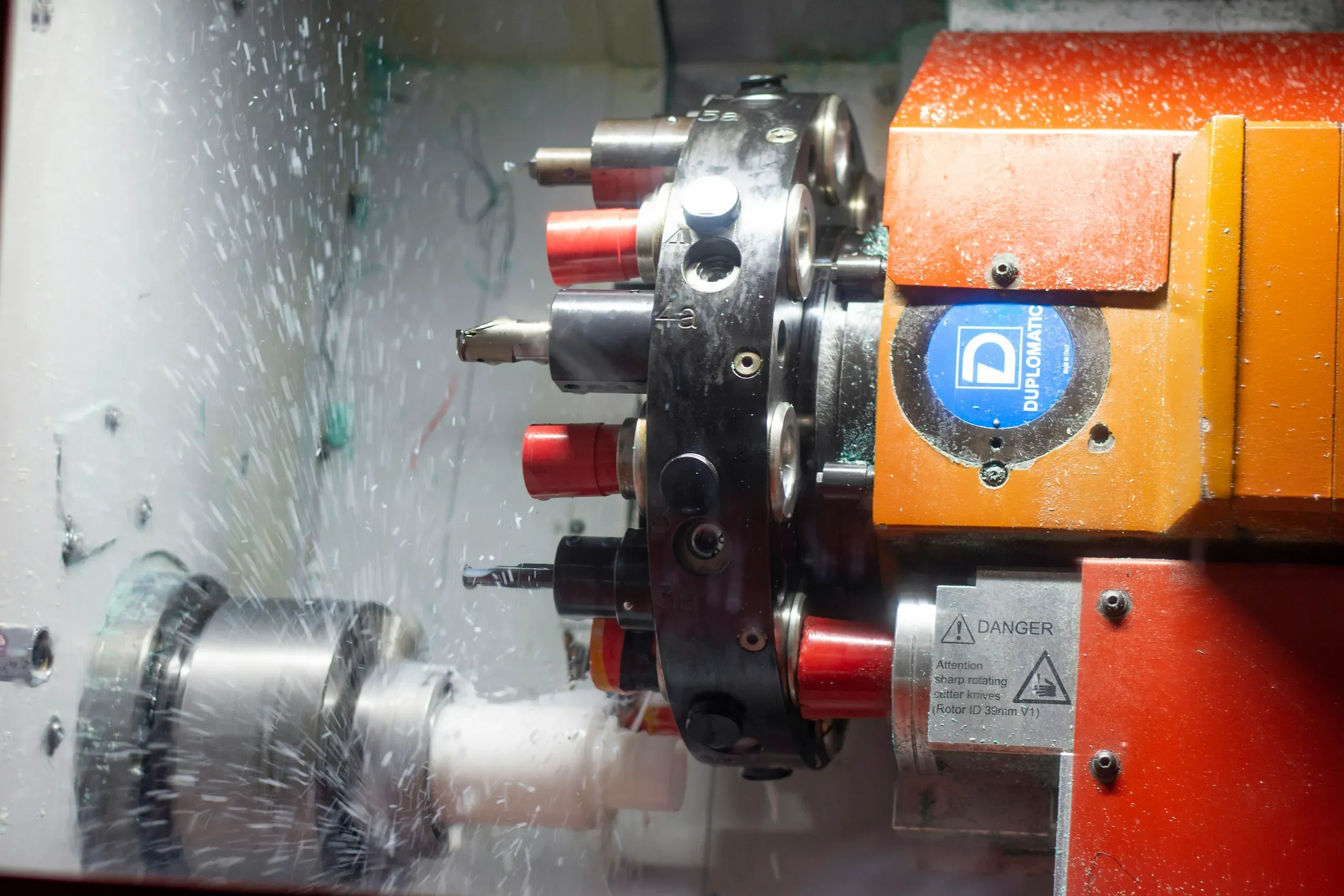
Shop capabilities
What we can do for your part: machining operations, complementary processes and the materials we work with.
Shop figures
- Typical working tolerance
- ±0.01 mm
- Milling centers
- 3 and 4 axes
- Maximum lathe swing
- Ø 500 mm
- The year we started
- 1974
Capabilities
In-house machining and processes coordinated with qualified suppliers
From turning to dimensional inspection: the operations we do in-house and the ones we coordinate with trusted suppliers.
Each capability links to its service when there is one; otherwise you can ask about it directly on WhatsApp.
CAD design and modeling
We model mechanical parts and components in 3D from drawings, specifications or physical samples, to make their development and manufacture easier.
See the serviceCAM programming
We prepare the machining programs and define tool paths according to the geometry of each part and the operations needed to make it.
See the serviceCNC machining
We make parts on CNC machines with programs adapted to their geometry: complex shapes and repeatable parts with a controlled process.
See the serviceConventional machining
Conventional lathes and mills to make, adjust and modify parts: ideal for one-off parts, short runs, repairs and in-process adjustments.
Ask on WhatsApp (opens WhatsApp)Metrology and dimensional inspection
We check part dimensions with measuring instruments and equipment, verifying they meet the tolerances and specifications in the drawings.
Ask on WhatsApp (opens WhatsApp)Laser cutting
We cut sheet metal with a 12 kW fiber laser: plates, brackets, panels and custom parts, plus signs and decorative panels. Materials and thicknesses per project.
See the serviceWelding
MIG/MAG, TIG and stick welding to repair, recover and rebuild metal parts: we fill worn areas and leave them ready for machining.
See the servicePrecision grinding
Grinding operations to adjust dimensions and reach the surface finishes mechanical components require, according to each part.
See the serviceReverse engineering
We analyze existing parts and rebuild their geometry in CAD to reproduce, repair or modify them, even when deteriorated, if technically feasible.
Ask on WhatsApp (opens WhatsApp)
Materials
Materials we machine
Each material explained in plain words: what it is and what it is used for. If your drawing calls for another, we source it or propose an equivalent.

Carbon steel
1020 · 1045 · A36 (black iron) · Transmission · Calibrated 1018/1020 · Galvanized · Mechanical tube
General-purpose steel: strong, affordable and easy to machine.
Used for: Shafts, bushings, pins and brackets.

Alloy steel
4140 · 4340 · 7210 · Chrome-plated bar (hard chrome)
Steel with chromium and molybdenum: carries more load and can be hardened.
Used for: Drive shafts, gears and highly stressed parts.

Tool steel
D2 · A2 · O1
Very hard and wear-resistant, especially after hardening.
Used for: Dies, punches, blades and molds.
Gray cast iron
Cast iron: machines well and damps vibration.
Used for: Bases, frames, pulleys and housings.
Wear-resistant steel
Hardox · Maxdur
Very hard plates that withstand abrasion and impact.
Used for: Wear plates, hoppers, blades and liners.

Stainless 304
304
The most common stainless: it does not rust in normal environments.
Used for: Food equipment, guards and parts exposed to moisture.

Stainless 316
316
Like 304, but more resistant to salt and chemicals.
Used for: Medical, marine and process equipment.

Hardenable stainless
420 · 17-4 PH
Stainless that can be hardened: harder, slightly less corrosion-resistant.
Used for: Pump shafts, valves and instruments.
Stainless 303 and 430
303 · 430 · Grade not specified
303 machines easily; 430 is economical and magnetic.
Used for: Fasteners, shafts, covers and decorative panels.

Aluminum
6061
Light, easy to machine and rust-free: the aluminum for almost everything.
Used for: Brackets, housings, plates and fixtures.

Bronze
C954 · Phosphor · Sintered · Alloy not specified
Slides well against steel and resists wear.
Used for: Bushings, bearings and thrust washers.

Malleable bronze (brass)
Very easy to machine, rust-free and electrically conductive.
Used for: Fittings, connectors and electrical parts.

Acetal
POM · Delrin®
A stiff, slippery plastic with very stable dimensions.
Used for: Gears, guides, bushings and precision parts.

Nylon
PA6
Tough and wear-resistant; it absorbs some moisture.
Used for: Wheels, pulleys, guides and insulators.

UHMW
UHMW-PE
Very slippery and impact-resistant; food-safe.
Used for: Conveyor guides, scrapers and wear plates.

PEEK
PEEK
High-performance plastic: withstands high temperatures and chemicals.
Used for: Medical, aerospace and laboratory equipment.

PTFE (Teflon)
PTFE · Teflón®
The most non-stick and chemical-resistant plastic.
Used for: Seals, gaskets, insulators and chemical-contact parts.
Acrylic
PMMA
Clear, rigid plastic that cuts and polishes easily.
Used for: Guards, viewing windows, covers and signs.
Bakelite
Rigid plastic that insulates against heat and electricity.
Used for: Electrical insulators, handles and mounting plates.
Polycarbonate
PC
Clear and highly impact-resistant.
Used for: Machine guards, viewing windows and covers.
Polypropylene
Lightweight plastic resistant to chemicals and moisture.
Used for: Tanks, chemical-handling parts and light guides.
Let's talk
Have a drawing or a part to reproduce?
Send us the drawing, a photo or the damaged part. We will reply with a quote and a lead time.